
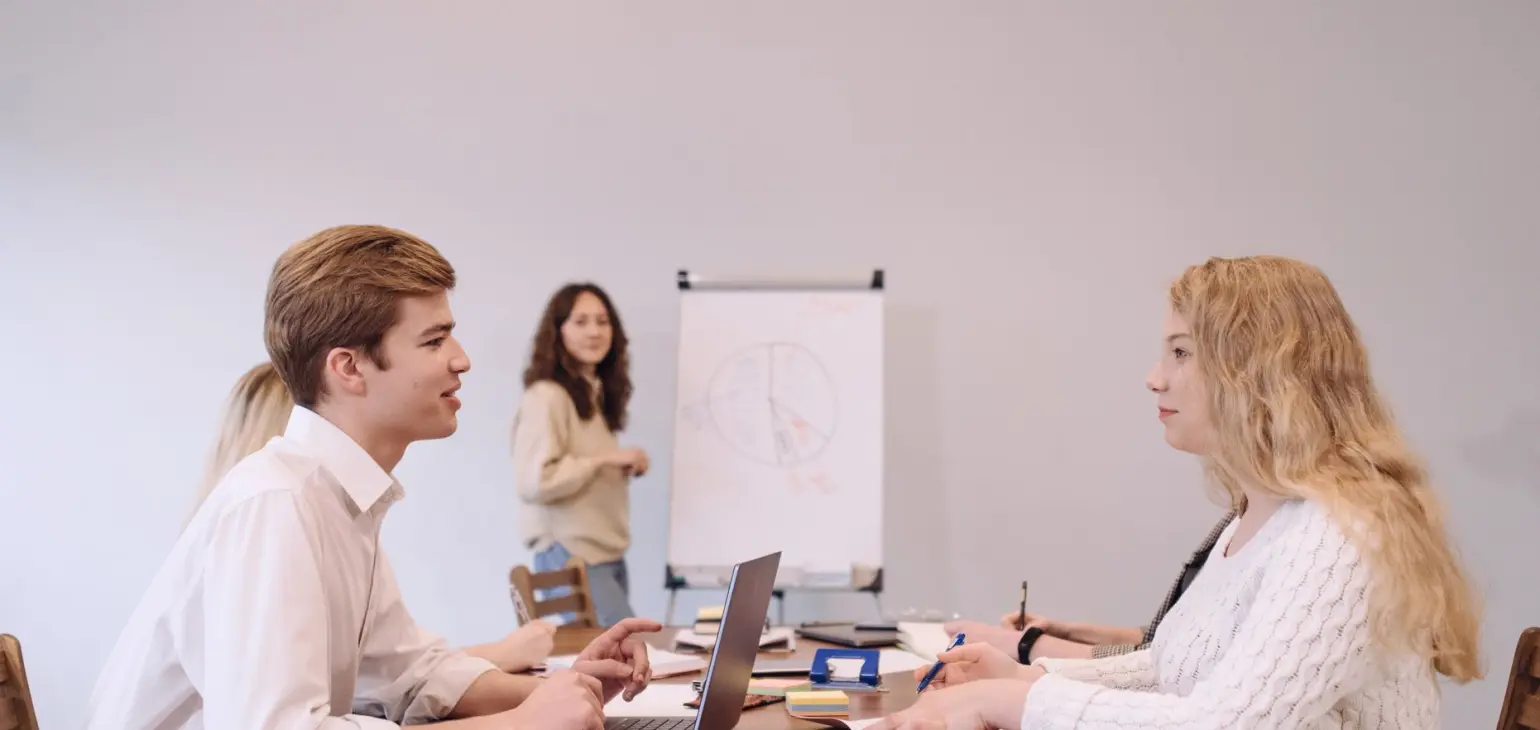
Why mid autumn suits a group session
Mid autumn is when many teams sit down to plan the rest of the year: the training calendar fills up, webinar series restart after summer, and onboarding videos for new colleagues get recorded before the holidays. A half-day workshop fits neatly into this stretch because people have just returned to a steadier routine and have room in their diaries.
It also helps that the days are shorter. Daylight changes in the office affect how a face looks on camera, and a workshop held now gives colleagues a chance to notice that early rather than in the middle of a deadline. We find that groups who practise together in these weeks arrive at December recordings with far less rushing.
Our team workshops are half-day sessions for colleagues who record training videos or host webinars together. The point is not to turn everyone into a broadcaster, but to give the whole group a shared way of speaking, pacing and looking at the lens.
Choosing who comes along
A workshop works best when the people in the room actually record or host something together. A trainer, the colleague who handles the webinar introductions and the person who reads announcements on camera will learn more from each other than from a mixed crowd with little in common.
Keep the group small enough that everyone has several turns in front of the camera. When too many people attend, most of the half day is spent watching, and watching is the least useful part. If your team is larger, it is better to split it into two sessions in different weeks.
Include at least one person who feels nervous. Their questions tend to be the ones the whole group is quietly asking, and the encouragement they receive sets a kind tone for the rest of the morning or afternoon.
- Colleagues who record or host together
- A group small enough for several turns each
- At least one self-described nervous speaker
What to bring and prepare beforehand
Ask each participant to bring a real script, however rough: a section of a training video, a webinar opening or an announcement they have to deliver soon. Working with genuine material keeps the practice relevant and means people leave with something they can use the following week.
If your team already has a recording setup, tell us what it is. A laptop camera in a meeting room is a different situation from a tripod and a prompter, and knowing the equipment lets us shape the exercises around what colleagues will really face.
Choose a room with a table, a power supply and enough space to move a chair back from the camera. Natural light is welcome, but plain overhead light is fine. Please also let participants know the session is practical, so they arrive ready to speak rather than to listen to slides.
- A real script from current work
- A note of your usual camera and recording setup
- A quiet room with seating and power
How the half day usually unfolds
We begin with a short warm-up for voice and posture, then move straight into reading aloud. Each person delivers a short passage, and the group notes what felt steady and where the pace ran away. The tone is encouraging; the aim is to notice habits, not to grade anyone.
The middle of the session turns to eyeline and framing, with colleagues taking turns on camera and watching playback together. Seeing yourself on a screen is uncomfortable at first, and doing it among peers makes it far easier to accept.
The final part is a rehearsal routine the team can repeat before any recording. Priya, who designs the workshops, builds in time for everyone to write down their own run-through so that it does not stay in the room when the session ends.
Feedback and practice materials afterwards
After the workshop, every participant receives written feedback on their delivery along with practice materials to use on their own. These are short exercises that take a few minutes at a desk, designed to be repeated before a recording rather than studied once and forgotten.
We suggest the team agree on one small habit to carry forward together, such as a shared warm-up before each recording or a quick read-through of the opening lines. Small shared habits stick better than long lists of advice.
If colleagues record training videos over the winter months, it helps to return to the practice sheets after the first few recordings and compare how things feel. Most people notice that the awkward parts have shifted, and that is the best sign the workshop did its work.
- Written feedback for each participant
- Short practice exercises to repeat
- One shared team habit to keep
A team workshop in these autumn weeks gives colleagues a calm, practical start to the busiest recording months. Bring real scripts, keep the group small, and agree on one shared habit afterwards. If your team records or hosts together and would like to feel more at ease, you are welcome to enquire about a session.